Stop treating the seller’s technology pack as the primary source of truth. Product claims, architecture slides, and “AI-ready” language are written to close a process. They are not written to show where value leaks after the price is set.
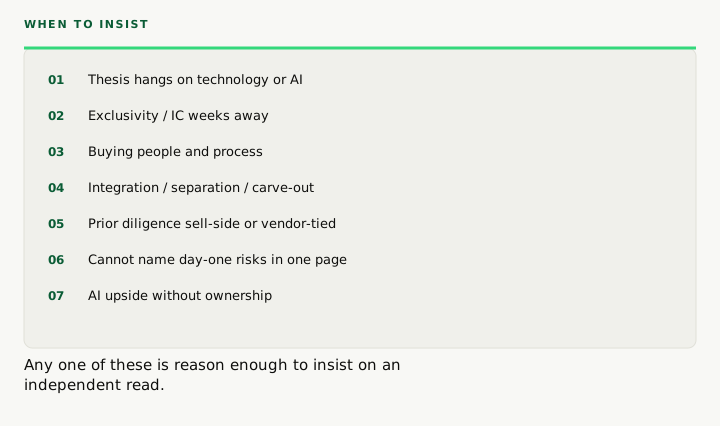
Insisting on technology due diligence is a decision, not a data-room checkbox. It means an independent read of what you are buying, where value leaks, and what day one and the first hundred days will demand — output for the deal team, before protections and price harden around optimism.
Technology Due Diligence is one of two mandates Booey Technology offers. The other is Fractional TECH CxO. This piece is about when the board should require the first.
What the board is actually asking for
An independent read answers three practical questions: what you are buying (product, platform, people, dependencies); where value leaks (debt, concentration, key-person risk, fragile integrations, AI claims that do not survive scrutiny); and what must be true on day one and through the first hundred days.
Independence here means not the seller’s narrative. It says nothing about anyone’s employment status. The view is written for the buyer’s decision — not to protect a seller story, a preferred integrator, or a remediation pipeline. If those incentives sit with the adviser, the board is still reading a story — just a different author’s.
Independence means not the seller’s narrative.
Board guidance is converging on the same point. The FT Agenda brief on cyber security and M&A notes that stand-alone cyber diligence is increasingly undertaken inside wider IT due diligence — and that reviewing a cyber policy on paper is not assurance. BDO lists IT and cybersecurity among explicit board pitfalls in M&A diligence, and urges independent advisors where technology debt, compatibility, and vulnerabilities matter to the thesis. Protiviti (Board Perspectives, 2024) likewise flags cyber and data privacy as risks that “lie hidden in the weeds,” and treats Day-1 readiness and integration effectiveness as board-relevant — not only IC slideware.
Trigger list: when the seller story is not enough
One trigger is enough. Several mean delay is expensive.
1. Thesis hangs on technology or AI. If valuation or growth assumes a platform, product moat, data advantage, or AI capability, the board cannot take the deck as gospel. Claims need an independent read before price hardens.
2. Exclusivity / IC weeks away. Process pressure is when narrative wins. Diligence that starts after exclusivity is already a concession to the seller’s calendar.
3. Buying people and process. Key-person risk and undocumented delivery habits rarely appear in the glossy pack. They show up in interviews and in how decisions actually get made.
4. Integration / separation / carve-out. Estate boundaries, shared services, licences, and data paths leak value quietly. Seller optimism about “clean separation” is a classic pre-close surprise.
5. Prior diligence sell-side or vendor-tied. A report written to support a process is not a read written for your IC. Familiarity is not independence.
6. Cannot name day-one risks in one page. If the deal team cannot list what must not break on completion — and who owns it — you have a story, not a technology view.
7. AI upside without ownership. Roadmap slides and unpaid pilots are not judgment. If AI is material to the thesis, assess governance, data readiness, and whether the capability is real or rented.
Pre-LOI vs pre-close — different jobs, same principle
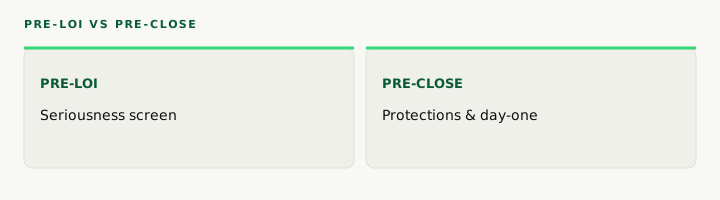
Pre-LOI — seriousness screen. Before exclusivity locks attention, technology diligence (or a sharp red-flag pass) tests whether the thesis hangs on claims technology cannot support. If the case depends on product velocity, platform strength, data moats, or AI capability, this is when you learn the roadmap is aspiration, the stack is a patchwork, or the “platform” is projects with a shared logo.
Pre-LOI should be proportionate. You are not reconstructing the estate. You are testing whether the story survives a senior look — and whether exclusivity is worth spending on this asset.
Pre-close — protections and day-one. Once exclusivity and IC timelines tighten, the job shifts from “is the thesis credible?” to “what are we signing for, and what must be true at completion?” Pre-close feeds price, warranties, indemnities, and the first-hundred-days plan. Value leak becomes concrete: remediation cost, separation or integration load, licence and vendor exposure, single points of failure, and claims that will not survive day-one operations.
Boards that wait until the week before signing often find the seller story was never false — it was simply never stress-tested against the deal’s real constraints.
Value leak — what boards miss when they skip the read
Value leak in technology deals is rarely a single catastrophic bug. It is the accumulation of deferred maintenance sold as “stable,” customer-specific forks dressed as a product, vendor lock-in that turns every change into a negotiation, knowledge that lives in a few people, resilience assumptions never tested against the buyer’s risk appetite, and integration plans that assume capacity the organisation does not have.
None of that requires inventing drama. It requires asking who owns the truth before the SPA freezes the narrative. Technology Due Diligence surfaces leak early enough to change price, protections, or walk-away — not to become a build programme after the fact.
Booey is not a delivery shop. Diligence shapes the decision; the client or their delivery partner builds. Findings should become a plan the board can use — not a reason to hire the diligence firm as the remediation army.
What good output looks like for the deal team
Useful technology diligence is short enough to use under IC pressure:
- What you are buying, stated so the deal team can use it
- Material risks and value leaks, ranked for the deal
- What must be true at signing and on day one
- What the first hundred days will force — without turning the adviser into the builder
- Clear gaps: what could not be verified and why that matters
If the pack cannot support a board conversation in that shape, it is documentation, not diligence.