You already have engineers. You may have an MSP, a project lead, or a delivery partner. What you often lack is someone who owns the trade-offs — where technology decisions meet the business.
Founders and CEOs reach for a hire, an agency, or a contractor. A hire takes time and a permanent cost. An agency sells a stack. A contractor closes tickets. None of them sits in the chair.
A fractional TECH CxO is that seat: senior leadership, on demand, on the terms you set.
The problem the hire and the agency do not solve
Between CTOs, before a permanent hire, or when a portfolio company needs a senior seat without a full-time cost, the question is not who ships the next sprint. It is who owns priorities, architecture, risk, and the board-ready answer.
Teams execute. Partners deliver. Without a clear owner of trade-offs, you get competing roadmaps, quiet technical debt, vendor decisions that look cheap until they are not, AI pilots that never become operating judgment, and board questions answered late — or by the wrong person.
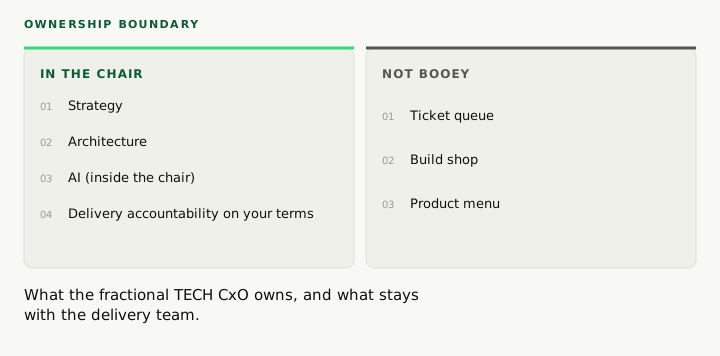
Fractional means a senior person in the chair for the mandate you define. Strategy, architecture, AI judgment, and delivery accountability on your terms. It does not mean becoming your build shop.
Demand for that seat is not theoretical. Business Talent Group’s 2024 High-End Independent Talent Report recorded a 67% increase in demand for CIOs, CTOs, and CISOs on an interim and on-demand basis — framed around organisations racing to adopt AI and harden cybersecurity — alongside a 47% rise for data, digital, and IT interim leaders more broadly. Fortune covered the same BTG release as a wider interim C-suite story; the signal that matters here is the tech chair, not a body-shop.
What sits in the chair
Strategy. What technology must do for the business over the next twelve to twenty-four months. What to stop. What to fund. How to sequence change so the company can absorb it. The chair turns commercial ambition into a technology agenda the board can recognise.
Architecture. How systems, data, and platforms fit together — and where they should not. Where coupling hurts. Where a rebuild is vanity. Where a quiet constraint will explode after the next raise or acquisition. Judgment, not diagrams for their own sake.
AI. AI sits inside the TECH CxO chair. It is not a separate CAIO product. Who owns AI risk, vendors, and whether a pilot earns its place? The same person who owns the rest of technology leadership. Vendors sell tools. The chair decides whether, where, and under what governance those tools belong.
Delivery accountability on your terms. The chair owns outcomes — priorities, quality bar, vendor and team choices, escalations — without becoming the workforce that writes every line. You set how deep the mandate goes, how often the chair is in the room, and what “done” means for the board.
The fractional TECH CxO owns strategy, architecture, AI, and delivery accountability on your terms.
Judgment and accountability in the seat. Build capacity elsewhere.
What Booey does not build
Booey Technology is not a delivery shop. We help shape the decision; you or your delivery partner builds.
We do not sell an infra, security, systems, or AI product menu. We do not turn the engagement into a catalogue of implementations. We do not compete with your engineering team or your existing partners for ticket volume.
If the right answer is a permanent CTO, we will say so. If the right answer is to keep your partner and tighten ownership, we will say so. The chair’s job is clarity — not a dependency on Booey as the builder.
How this differs from contractors
Contractors and specialists are valuable. They are not the same seat.
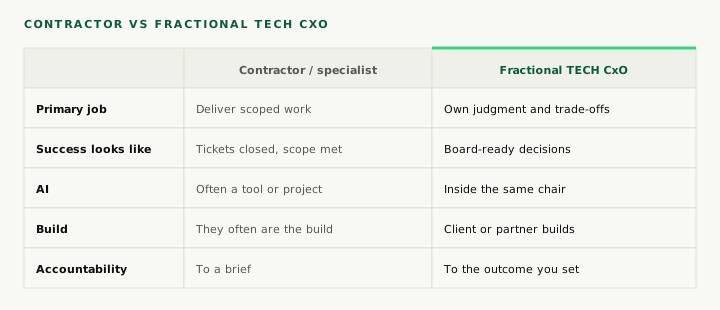
A contractor answers whether you can ship X. A TECH CxO answers whether you should — in this order, at this risk, with this team and these vendors — and how you tell the board.
Agencies blur the line when they package leadership as a by-product of selling a stack. Leadership that depends on selling you more build is not independent judgment. Excellent contractors still leave the ownership gap open unless someone else owns the portfolio of decisions.
When fractional is the right shape
Fractional TECH CxO fits when you need senior technology leadership without waiting for a hire, or without carrying a permanent cost you are not ready for.
- Pre-hire or between CTOs — continuity of judgment while you recruit
- Growth stage — strategy and architecture outrun the team’s bandwidth for trade-offs
- Portfolio / PE context — a seat in the company without a full-time CxO on day one
- AI pressure — the board expects a view; you need ownership, not another pilot
It is the wrong shape when you mainly need hands on keyboards, or when you want a firm to own implementation and claim strategy as a free add-on. Hire delivery or a permanent leader, and keep the chairs distinct.