Buyers are being offered AI as if it were a third product — a separate chair, a separate mandate, a separate invoice. Fractional CAIO retainers and AI strategy packages answer a market fashion. They do not answer who owns AI risk, vendors, and pilots when those choices collide with architecture, delivery, and the board.
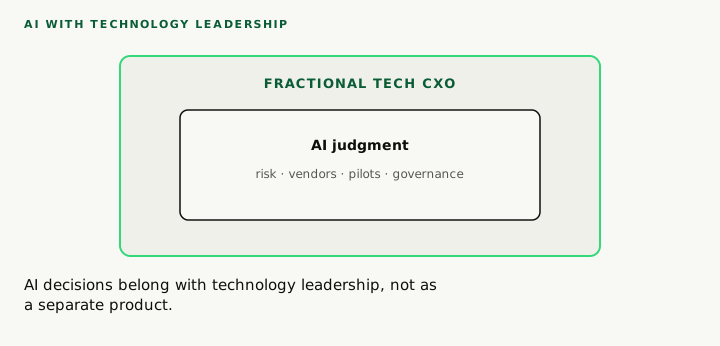
AI judgment belongs in the same seat as technology leadership. Not beside it.
Technology leadership, on demand — with AI as a capability of the Fractional TECH CxO chair, not a SKU you buy on its own.
Why a separate AI chair confuses the decision
Boards feel pressure to have an AI view. Vendors sell tools with executive-sounding names. Some packaging treats fractional AI leadership as if AI lived apart from the rest of technology.
It does not.
AI decisions are technology decisions. They touch data readiness, architecture, vendor lock-in, security posture, operating cost, and what you tell the board when a pilot fails to become a product. Splitting that into a separate AI chair creates two owners for one set of trade-offs — or an AI owner with no mandate over the systems that make AI real.
The ownership fight is real. Harvard Business Review (Toby E. Stuart, March 2026) frames who in the C-suite should own AI as a decision-rights and power problem — CIO, COO, CFO, and others contending for control — not a job-title product to buy off a menu. BCG (June 2026) is blunt that the title matters less than the mandate: ungoverned AI is enterprise risk, and the CIO (or shared tech mandate) must orchestrate intent, digital labour, value, and control. CAIO theatre without that orchestration fails; AI judgment inside the TECH CxO chair fits the mandate-over-title line.
At Booey Technology, AI sits inside Fractional TECH CxO. We do not sell a third public mandate. Technology Due Diligence remains the other offer — and AI appears there only when claims sit in a deal thesis, not as a product line.
How AI shows up inside a TECH CxO mandate
Inside the chair, AI is not a workshop series and not a slide titled “transformation.” It shows up as judgment the business can use.
Risk. What could go wrong — data exposure, model dependency, vendor concentration, decisions that look clever until they are audited. The chair names material risk in language the board recognises, without pretending regulation alone is the strategy.
Vendors. Tool markets move fast and sell urgency. The chair decides whether a vendor belongs in the operating model, under what terms, and what you refuse. Buying a model or a platform is easy. Owning the dependency is the job.
Pilots. Pilots are useful when they answer a question the business will act on. They are expensive when they exist mainly to signal modernity. The chair kills pilots that cannot graduate, funds the few that should, and stops the organisation confusing demos with capability.
Governance. Who may use what, on which data, with which escalation path, and how success is measured. Governance is not a binder. It is the operating rules that keep AI inside risk appetite while delivery continues. The same person who owns architecture and delivery accountability should own those rules — or the rules will not survive contact with the sprint board.
AI judgment belongs in the same seat as technology leadership. Not beside it.
That is AI inside the chair: risk, vendors, pilots, and governance as part of technology leadership — not a parallel product.
Judgment in the seat vs a tool vendor
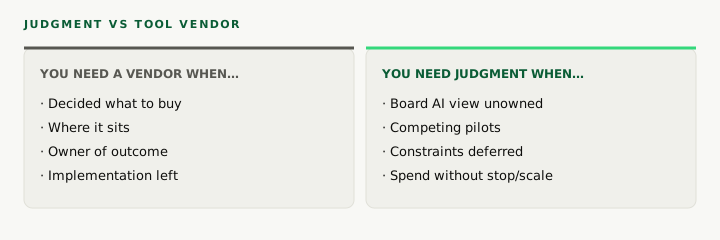
You need a vendor when…
- You have already decided what to buy
- You know where it sits in the estate
- Someone inside owns the outcome
- The remaining work is implementation and support
You need judgment in the seat when…
- The board asks for an AI view and nobody owns the answer beyond a vendor pitch
- Several pilots compete for attention and none has a path to production ownership
- Data, security, and architecture constraints are treated as “later” while demos run now
- AI spend is rising and you cannot name what stopped, what scaled, and why
The Fractional TECH CxO shapes those decisions. The client or their delivery partner builds. Booey is not a delivery shop and not a reseller dressed as leadership. If the right answer is “do not buy this tool,” that is the job. If the right answer is “hire permanent capacity,” that is the job too.
Calm ownership, not a hype stack
Hype stacks sell certainty: a maturity model, a roadmap wallpaper, a centre of excellence that exists mainly on slides. Activity sold as progress looks impressive from the gallery and leaves ownership untouched.
Calm AI leadership sounds less dramatic. It says what the company will and will not do with AI in the next planning cycle. It ties spend to decisions the business can absorb. It keeps systems, estate, and security judgment inside the same chair — not spun out as new product lines because the market invented new nouns.
AI is material. It is not mystical. Treat it as part of technology leadership and the packaging pressure fades. Treat it as a separate product and you will keep buying chairs until someone finally owns the trade-offs.
One chair, two offers
Booey Technology offers two mandates: Fractional TECH CxO and Technology Due Diligence. AI lives in the first as chair capability. It appears in the second only when AI claims matter to what you are buying. There is no third product to add to the menu.
Technology leadership, on demand — AI included, in the seat.