Software as a Service (SaaS) is the standard way most organisations buy business software. The commercial model is simple: a monthly licence for each user, with the customer's own staff doing the work inside the tool.
That model has three structural limits. Cost rises with headcount rather than with value delivered. Tools accumulate team by team, and many are under-used. Most importantly, the software does not do the work; it supports the people who do.
AI agents change that. Agents can now carry out a large share of routine work inside business systems, reading, checking and updating records much as an employee would. When the software performs the work, pricing per user becomes harder to justify.
What Agentic as a Service (AaaS) is
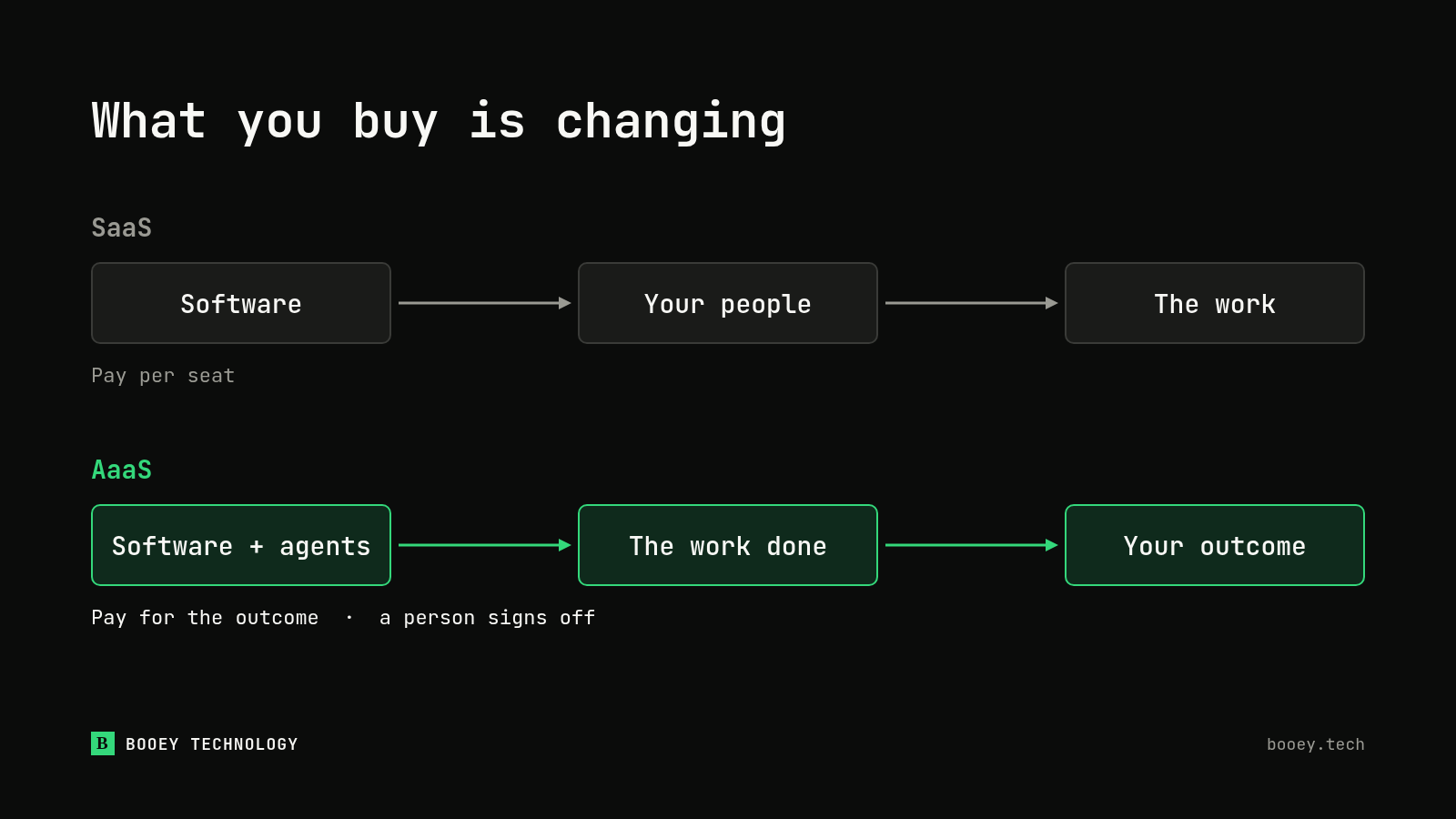
AaaS combines software and agents into a single service. The customer pays for an agreed outcome, delivered to a defined standard, rather than for user licences.
Accountability remains with people. A named person defines the job, agrees the quality standard, reviews the output and approves anything material. The agents carry out the steps in between.
The distinction is commercial as much as technical.
SaaS sells access to a tool. AaaS sells the outcome.
Who owns what
Under SaaS, the provider supplies the tool and the customer's team performs the work.
Under AaaS, the provider takes responsibility for the work. It operates the agents and is accountable for the quality of the output. The customer defines the job and the standard, and gives final approval.
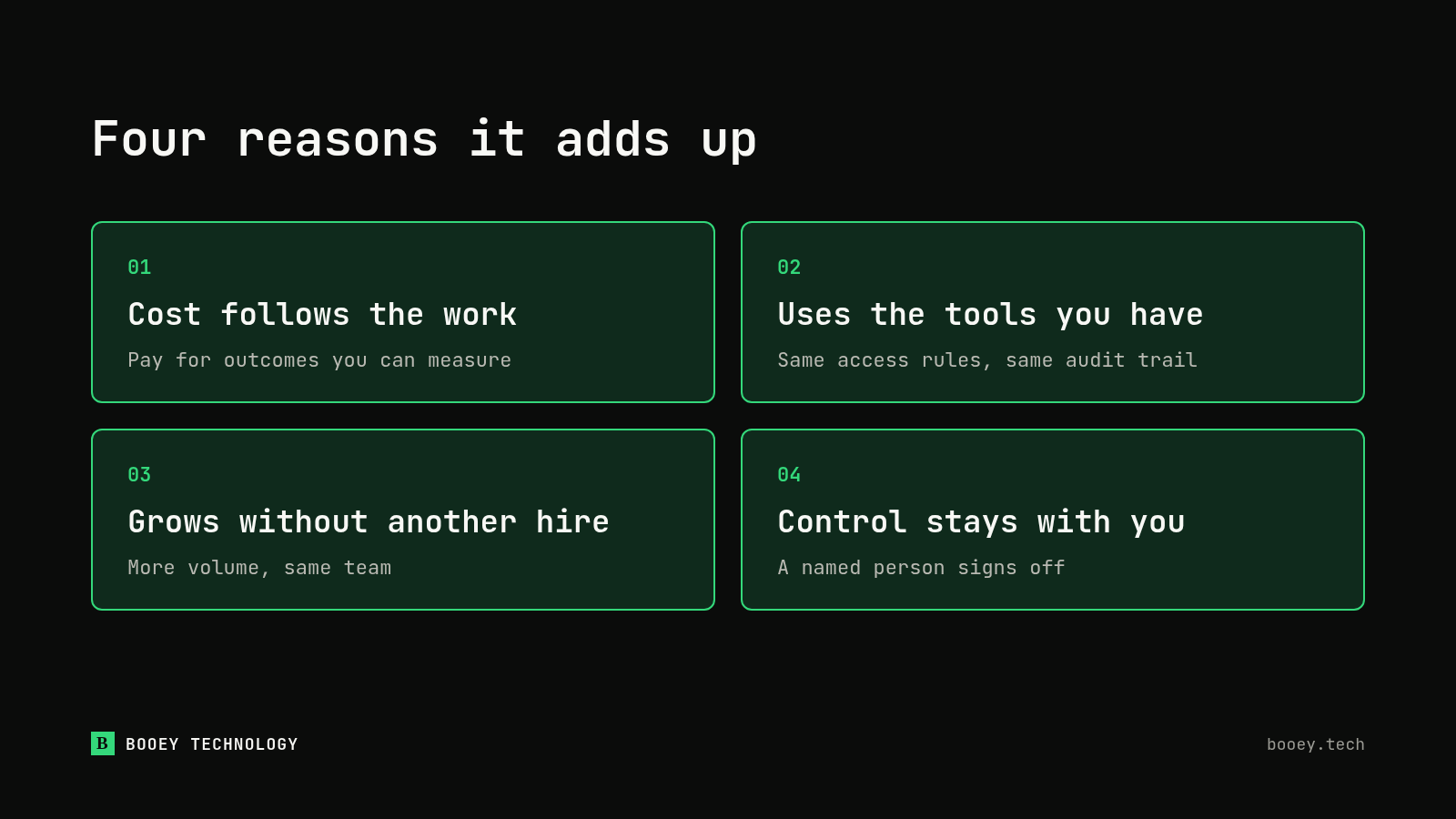
In a well-run AaaS model, the work takes place in the customer's existing systems, under its access controls, with an auditable record of each step.
| SaaS | AaaS | |
|---|---|---|
| What the customer pays for | User licences | An agreed outcome |
| Who performs the work | The customer's team | The provider's agents |
| Who approves the output | The customer | The customer |
Why it makes sense
Most organisations do not lack software. They lack capacity to get routine work done reliably and on time: reporting delivered on schedule, controls performed before issues escalate, and customer enquiries handled promptly. AaaS is designed around that need.
Cost follows results. Spend is tied to measurable outcomes, which makes value easier to assess.
Expectations are set in advance. Scope, turnaround and quality standards are agreed before work begins.
Capacity scales with demand. Higher volumes do not automatically require additional hires.
Control stays with the customer. A named person approves the output, so ownership of each result is clear.
How Booey Technology uses it
Booey Technology operates on this model. Agents carry out much of the day-to-day work across the business, under one consistent rule: agents prepare and check, a person reviews and decides.
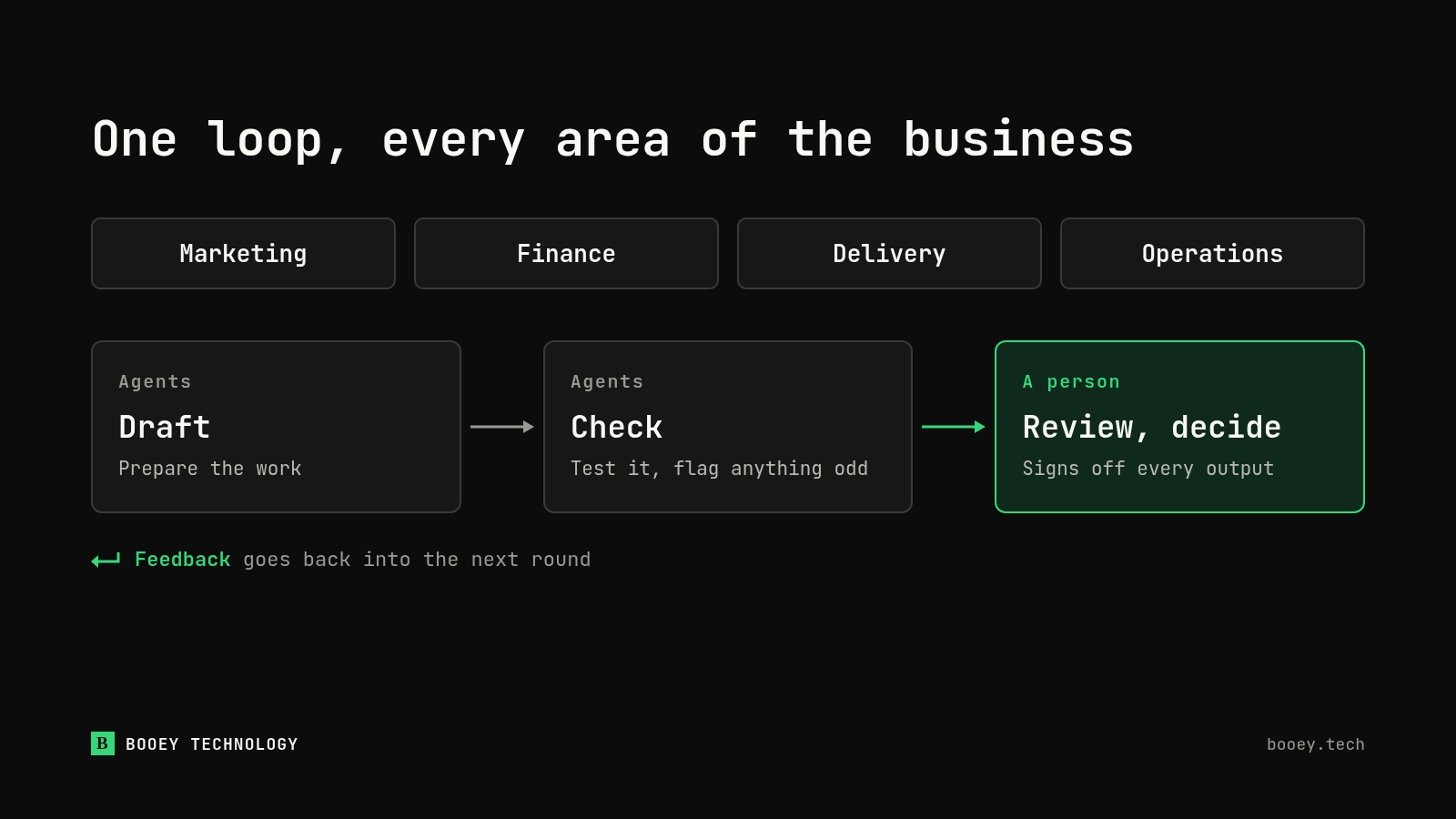
Marketing. Agents draft content for editing, monitor relevant news and report on performance to inform decisions.
Finance. Agents reconcile the books, flag exceptions and prepare invoices for review. Nothing is sent or paid without approval.
Delivery. Agents support software development and testing. Every change is checked before release, and every release requires sign-off.
Operations. Agents track open work and escalate the decisions that need a person.
The main lesson is that the agents are rarely the constraint. A clear definition of the job is. Where the job and the approval step are well defined, the model performs well. Where they are not, activity increases without a matching increase in output.
Where to start
Start with a single recurring task that is easy to verify. Run it through agents for a few weeks, with a person approving each output, and assess the results before extending the approach.