The deal closes. The thesis is still warm. Somewhere in the pack sits a technology diligence report — or a seller story that stood in for one. Then the calendar starts: day one, week one, the first hundred days.
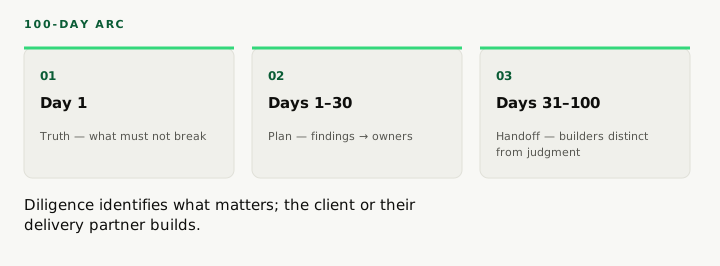
What those days demand is rarely the integration fantasy that survived IC. They demand truth about what you bought, a plan that turns findings into ownership, and continuity of judgment — without hiring the diligence adviser as a delivery army.
This piece is for PE leads, boards, and ops sponsors after close. Technology Due Diligence is the mandate. Fractional TECH CxO appears only where the board still needs a seat after the report is filed. Two offers. No build circus.
Day-1 truth vs integration fantasy
Day one is unromantic. Systems must stay up. Access must work. Key people must still answer the phone. Licences, shared services, and data paths that looked fine in the data room meet the buyer’s risk appetite and how the seller actually operates.
Integration fantasy assumes capacity the organisation does not have: clean separation in weeks, consolidation without downtime, AI upside that was only a pilot, culture that absorbs change because the SPA said so. Fantasy is not always dishonest. It is usually under-tested.
Day-1 truth asks different questions:
- What must not break on completion — and who owns it tonight?
- Where does knowledge live if three people leave?
- Which vendor and licence dependencies become the buyer’s problem at signing?
- What did diligence flag that still sits in a slide, not in an owner’s calendar?
If the deal team cannot answer those without hedging, the first hundred days will invent the answers under fire. Technology Due Diligence, done properly, should have made day-1 truth visible before price hardened. After close, the job is to act on it — not to rediscover it.
AlixPartners (January 2024) treats the first hundred days as foundational for value-creation plan execution: right leadership, a coherent narrative, and a bullet-proof plan with accountabilities — not a rewrite of the estate before Day 30. Their VCP tiers put Day-1 quick wins and no-regret moves first; structural tech moves such as cloud migration and modernisation sit further down the line. Weak TMO/IMO governance is a common failure mode; continuity of customers and people sits alongside integration success. That reading matches the C2 board spine: Protiviti treats integration effectiveness and Day-1 readiness as board-relevant, and the FT Agenda cyber M&A brief notes it is cheaper to integrate cyber from the outset than to bolt it on later.
DD findings should become a plan, not a slide deck
A diligence pack that impresses IC and then gathers dust has not finished its job.
Findings earn their keep when they become a sequenced plan the operators can run.
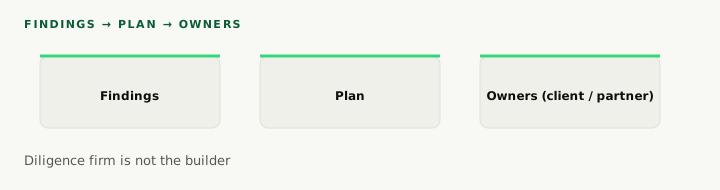
A usable post-close plan is short enough for operators:
- Material risks and value leaks, ranked for the first hundred days — not an encyclopaedia
- Owners inside the company or named partners — not “the diligence firm will handle it”
- Decisions the board must take early (spend, stop, hire, renegotiate) versus work that can wait
- Gaps that could not be verified pre-close, and how you will close them without stopping the business
Independence still matters after close. Independence means not the seller’s narrative and not a remediation sell-on. It does not mean anything about anyone’s employment status. If the only path from findings to action is hiring the same firm as the builder, the board is reading incentives again — just later in the process.
Booey Technology is not a delivery shop. Diligence shapes the decision; the client or their delivery partner builds. The first hundred days should prove that boundary, not erase it.
Continuity of judgment — chair, not army
Some boards need more than a report after close. They need a senior person in the technology seat while the company absorbs the deal: priorities, architecture trade-offs, vendor calls, risk language the board trusts. That is continuity of judgment — Fractional TECH CxO when the mandate fits — not an implementation battalion from the diligence provider.
Hiring a delivery army from the firm that wrote the findings creates a familiar distortion: remediation volume becomes the business model, and the chair’s job — what to do, in what order, at what risk — gets buried. Excellent delivery partners remain essential. They are not a substitute for ownership of trade-offs.
Use the chair when:
- There is no permanent technology leader yet, or the seat is contested after close
- DD findings are clear but nobody inside owns sequencing and board answers
- Integration or separation work needs executive judgment, not only project management
- AI, estate, or security claims from the thesis need ongoing ownership — still inside the CxO chair, not as new product lines
Do not invent a third mandate for systems, estate, or security. Those stay inside TECH CxO judgment when a seat is required. Technology Due Diligence remains the post-close truth instrument; the chair is continuity when the board needs a person, not a programme brochure.
Handoff to the client or delivery partner
A clean handoff is part of the hundred-day reality. Findings and priorities should travel in a form a delivery partner or internal team can execute: scope, constraints, acceptance criteria, and what “good” looks like for the board. The adviser who shaped the decision should not need to become the workforce that implements it.
That handoff also protects independence. When Booey’s job ends at clarity — or continues only as Fractional TECH CxO judgment on terms you set — the company keeps the right to choose who builds. That is not a captive pipeline into Booey as builder.
If the right answer after close is permanent leadership, say so early. If the right answer is to keep the existing partner and tighten ownership, say so. The first hundred days punish vanity programmes and reward owned decisions.
What the first hundred days actually buy you
Done well, the first hundred days buy a company that knows what it bought, has owners for the risks that matter, and has moved findings off slides into calendars. Done poorly, they buy activity: war rooms without decisions, integration plans without capacity, and a quiet return to the seller story because nobody wanted to own the harder version.
PE and board sponsors do not need branded playbook IP. They need day-1 truth, a plan from diligence, continuity of judgment when a seat is missing, and a handoff that keeps builders distinct from decision-makers.
Use Technology Due Diligence when the truth still has to be earned after the ink is dry. Use the Fractional TECH CxO chair when you need a seat. Technology leadership, on demand.